There is a reason a walk through the woods lowers your heart rate before you've gone fifty feet, and it's the same reason a hospital room with a view of trees discharges patients faster than one facing a brick wall. Humans are wired to seek connection with the natural world, a phenomenon biologist Edward O. Wilson termed "biophilia." In the context of interior design, biophilic principles are no longer a fringe wellness trend but a rigorous, research-backed approach to shaping rooms that reduce stress, sharpen focus, and simply feel better to inhabit. For homeowners weighing a renovation, biophilic design offers something rare: a strategy that elevates both aesthetics and measurable well-being.
Why Biophilic Design Works
Studies from Terrapin Bright Green, a leading environmental consulting firm, have found that biophilic elements in workplaces can boost productivity by 8 percent and improve well-being scores by as much as 13 percent. Hospitals have documented shorter recovery times for patients with access to natural light and greenery. The mechanism is straightforward: our nervous systems evolved in environments rich with organic texture, filtered light, and living things, and interiors that mimic those conditions trigger a genuine physiological calm, not just a stylistic preference.
Start With Light, Not Plants
Most homeowners assume biophilic design begins with a fiddle-leaf fig, but the foundation is actually daylight. Rooms with access to natural light and views of greenery consistently outperform plant-filled but dim spaces in occupant satisfaction surveys. Before shopping for foliage, audit your windows:
- Swap heavy drapery for sheer linen panels, which can increase usable daylight by 20 to 30 percent while preserving privacy.
- Trim exterior landscaping that blocks window sightlines; even a partial view of a tree canopy has measurable stress-reducing effects.
- Consider solar tubes for interior bathrooms or hallways lacking exterior walls. At roughly $500 to $1,000 installed, they're a fraction of the cost of a skylight ($1,500 to $3,000+) and can transform a windowless powder room.
Material Choices That Read as "Alive"
Biophilic design divides into direct nature (plants, water, daylight) and indirect nature (materials and patterns that evoke natural systems). The latter is often more achievable in a renovation budget. Consider:
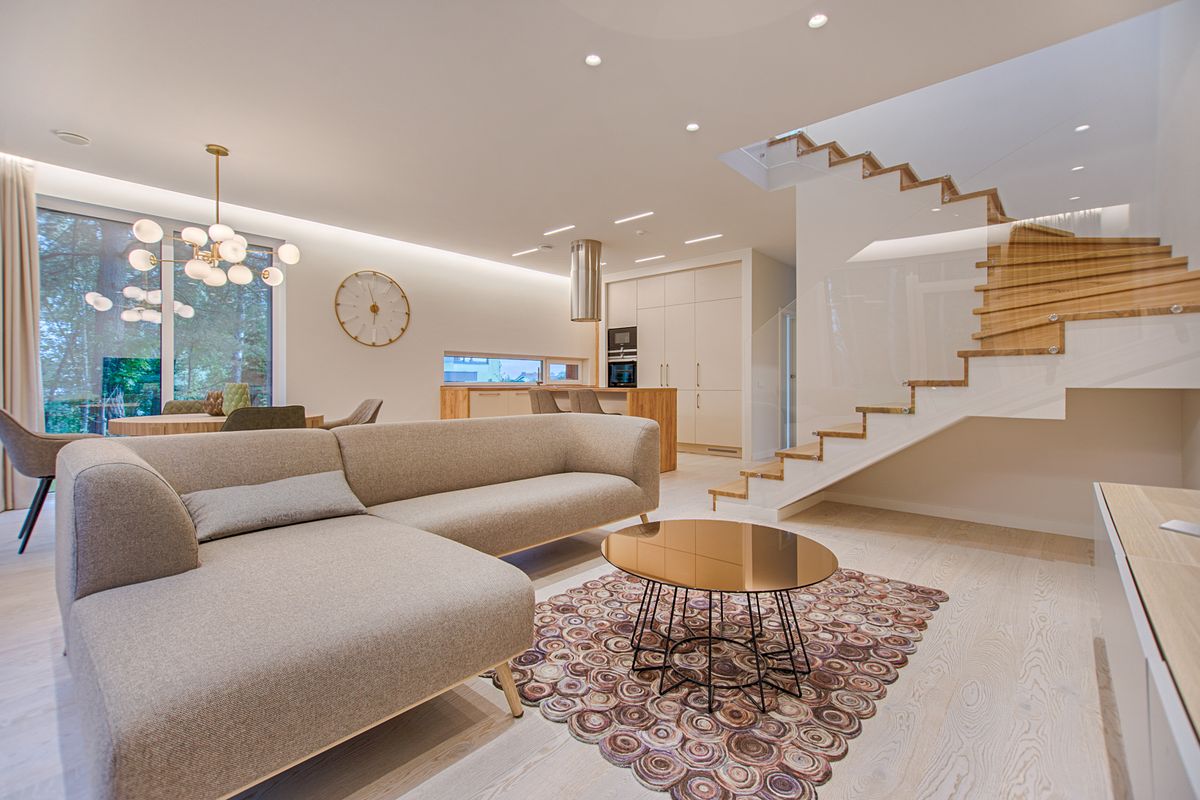
- Wood with visible grain. White oak, walnut, and ash flooring or cabinetry ($8 to $18 per square foot for engineered options) reads as organic in a way that painted MDF never will.
- Natural stone. Honed marble, soapstone, or travertine countertops introduce the kind of asymmetry and veining the brain associates with the outdoors, at a premium of roughly 15 to 25 percent over quartz.
- Textiles with texture. Jute rugs, linen upholstery, and wool throws add tactile variation that mimics the irregularity of natural surfaces, often for under $200 per piece.
Even a modest kitchen refresh that swaps laminate for a butcher-block island top (around $40 to $60 per linear foot) can shift a room's entire sensory register.
Plants: Where They Actually Belong
Greenery remains the most visible signature of biophilic interiors, but placement matters more than volume. A single well-chosen specimen in the right light does more than a dozen struggling plants crowded into a dark corner.
- Kitchens: Herbs on a sunny windowsill double as both décor and function.
- Bathrooms: Humidity-loving species like pothos, ferns, or orchids thrive in steam and soften hard tile surfaces.
- Home offices: A snake plant or ZZ plant tolerates low light and improves indoor air quality, which studies link to modest gains in cognitive performance.
- Living rooms: A statement tree, such as a fiddle-leaf fig or olive tree, anchors a seating area the way a piece of art would, typically running $75 to $300 depending on size.
Water and Sound
Water features scaled for interior use, tabletop fountains, a small wall-mounted panel, or even a fish tank, introduce ambient sound that masks street noise and lowers cortisol levels according to acoustic ecology research. A quality tabletop fountain runs $50 to $150, while a built-in wall feature can range from $2,000 to $5,000 installed, generally reserved for larger renovation budgets.
Planning Before You Build
Because biophilic design touches nearly every surface and system in a room, from window placement to material sourcing, it benefits enormously from visualization before construction begins. Homeowners increasingly turn to AI room design tools like RemodelAI to test how a room might look with expanded glazing, natural stone counters, or a living wall before committing to a contractor's estimate. This kind of previsualization can prevent costly mid-project changes and helps homeowners communicate their vision clearly to architects and designers.
A Design Philosophy, Not a Checklist
The rooms that succeed most fully at biophilic design rarely announce themselves as such; they simply feel calmer, more textured, more alive than the spaces around them. Whether the renovation budget is $2,000 for textiles and a few well-placed plants or $50,000 for a full glazing and